AI can take a lot of tedious work out of recruiting. It can also make unfair decisions at scale, quietly and with an air of objectivity. If you build an applicant tracking system (ATS) or other HR tech, you are responsible for which of those outcomes your customers get. Buyers now ask about fairness, explainability and compliance in the first sales call, and regulators in several jurisdictions expect answers.
This guide is for product and engineering leaders who want to add AI to recruitment software without creating a liability. It covers where AI earns its place, where it gets risky, and the design patterns that keep people in charge.
Where AI genuinely helps
The safest and most valuable uses of AI in recruiting reduce administrative work without deciding who gets hired.
- Resume parsing. Turning PDFs, Word files and job board exports into structured profiles saves recruiters hours. Let recruiters confirm key fields, because parsers still misread unusual layouts.
- Job description drafting. A model can produce a first draft from a few notes and flag exclusionary language. A hiring manager should edit and approve the final text.
- Matching and ranking. Comparing a candidate’s skills and experience against the job’s stated requirements helps recruiters prioritize a large pile of applications. This is the highest-risk item on the list, and most of this guide is about doing it well.
- Interview scheduling. Calendar integration and candidate self-scheduling remove endless email threads with little fairness risk.
- Candidate communication. Drafted status updates, rejection notes and answers to common questions keep candidates informed. A person should review anything that communicates a decision.
Where it gets risky
Risk rises as AI moves from assisting to deciding. Be cautious with:
- Automatic rejection. Any system that filters candidates out without a person looking is making an employment decision.
- Opaque scores. A single number with no explanation can’t be challenged by a recruiter or explained to a candidate.
- Training on past hiring outcomes. Historical decisions may reflect past bias, and a model trained on them can learn to repeat it.
- Video, voice and personality analysis. Inferring traits from facial expressions or tone is scientifically contested. The EU AI Act prohibits emotion recognition in the workplace except for medical or safety reasons.
Design principles for responsible AI screening
Make match scores explainable
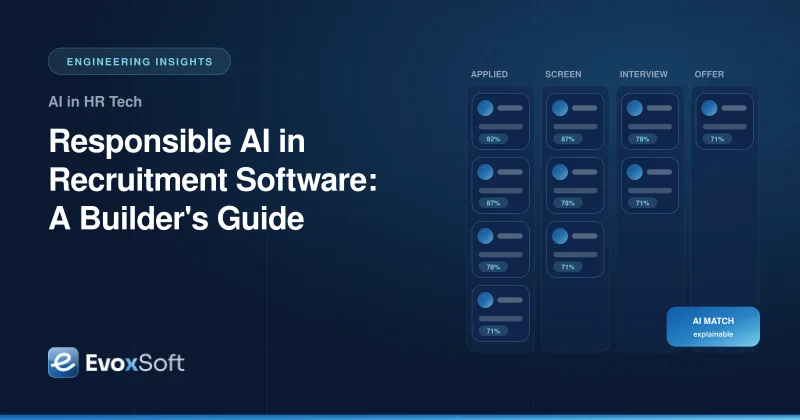
Every score should come with its evidence: which requirements the candidate met, which were missing, and where in the resume the evidence came from. Scoring against the job’s stated requirements, rather than against a vague notion of a “good hire,” makes the logic easier to inspect. If you use embeddings or a language model for semantic matching, have it produce structured, cited reasons rather than a bare similarity number. Recruiters trust scores they can check, and candidates can get a meaningful explanation.
Keep humans in the decision
Design the workflow so the AI ranks and explains, and a person advances or rejects. Make that human action explicit and recorded. Watch for rubber-stamping: if recruiters bulk-reject everyone below a score threshold, you have automated rejection with extra steps. Useful safeguards include showing the evidence before the action buttons, sampling low-ranked candidates for review, and limiting bulk actions.
Exclude protected attributes and their proxies
Removing name, gender, age, photo and date of birth from the model’s input is the start, not the finish. Many fields act as proxies:
- Graduation years reveal approximate age
- Names of clubs, schools or associations can reveal gender, ethnicity or religion
- Postal codes can correlate with race and income
- Employment gaps can reflect caregiving or disability
Decide which fields the model may see, test whether its outputs still correlate with protected groups, and document the reasoning.
Offer blind review
Masking identifying details in the recruiter view during early screening reduces human bias as well as model bias. Reveal the full profile once a candidate advances. Make this a per-tenant or per-job setting, since some roles and jurisdictions have different expectations.
Monitor for adverse impact
Fairness is something you measure continuously, not a one-time property. Compare selection rates across demographic groups at each stage of the pipeline. In the US, the “four-fifths rule” from the Uniform Guidelines on Employee Selection Procedures is a common first screen: a group’s selection rate below 80% of the highest group’s rate is a signal to investigate. Demographic data for this monitoring should come from voluntary self-identification, stored separately from the profile the model and recruiters see.
Keep audit logs
Log every AI output and every human action: the model and version used, the inputs it saw, the score and evidence it produced, and who made which decision and when. These logs support bias audits, customer investigations and candidate requests. Make them tamper-evident and scoped to each tenant.
Handle consent and data retention deliberately
Tell candidates when AI is used and what it does. Collect only the data you need, set retention periods per tenant and region, and run automated deletion jobs rather than relying on manual cleanup. Deletion should reach backups, search indexes and any vector stores that hold resume embeddings.
Read your vendor’s model terms
If you call a third-party model API, check whether the provider may retain prompts or use them for training, where data is processed, and what sub-processors are involved. Choose enterprise terms or regional deployments that match your customers’ data residency needs, and reflect them in your data processing agreements.
The regulatory landscape, at a high level
Rules on AI in hiring are evolving quickly. A few are already shaping how products are built:
- New York City Local Law 144 regulates automated employment decision tools used for candidates and employees in the city. Employers must have an independent bias audit done within the year before using a tool, publish a summary of the results, and notify candidates that the tool is being used.
- The EU AI Act classifies AI systems used for recruitment and selection, such as filtering applications and evaluating candidates, as high-risk. High-risk systems carry obligations around risk management, data governance, technical documentation, logging, transparency and human oversight, split between the provider who builds the system and the employer who deploys it.
- The GDPR applies to candidate data from people in the EU. It requires a lawful basis for processing, data minimization, limited retention and transparency. It also gives people rights around decisions based solely on automated processing that significantly affect them, which is another reason to keep humans in the loop.
Other US states and cities, and other countries, have passed or proposed their own rules, and existing anti-discrimination law applies whether or not a decision involves AI. This section is a general overview, not legal advice. Get advice from qualified counsel in the jurisdictions where you and your customers operate.
Build governance into the product
The patterns above are much cheaper to build in from the start than to retrofit. In practice that means:
- A model registry that records which model and prompt version produced each output
- Tenant-level settings for masking, blind review, retention and AI features
- Built-in adverse impact reports customers can export for their own audits
- Documentation that describes what each AI feature does, what data it uses and its known limitations
Our AI recruitment ATS platform blueprint shows how these pieces fit into a multi-tenant architecture, and the AI multi-tenant HRMS platform blueprint covers the wider HR suite beyond hiring.
Build it right from the start
Responsible AI in recruiting is a product decision as much as an engineering one. Our custom software development team builds ATS and HR platforms with explainability, oversight and data controls designed in, and our IT consulting team can review an existing product’s AI features and governance. If you’re planning AI features for your hiring product, talk to us.