A recruitment software company wants one applicant tracking system that serves many employers and staffing agencies, each with its own careers site, hiring stages and data rules. This blueprint shows how we build it with AI that helps recruiters move faster, while hiring decisions stay with people and every tenant's candidates stay private.
This is a solution blueprint: a representative engagement showing how we approach this kind of project. It is not a specific client story.
IndustryHR Tech & Recruitment
Timeline6–8 months to a production MVP
Teamproduct lead, 5 engineers, 1 designer, 1 ML engineer, part-time DevOps and QA
The Challenge
Recruiters spend hours reading resumes that arrive as PDFs, Word files and job board exports in different formats.
Each employer wants its own branded careers page, hiring stages, scorecards and email templates.
Candidate data falls under GDPR and similar laws, with consent, retention and deletion requirements that vary by region.
AI screening in hiring is regulated in several jurisdictions, and buyers need to show it is fair, explainable and overseen by humans.
What the Solution Delivers
Branded careers sites and hiring pipelines configured per tenant, including custom domains
Resumes parsed into structured profiles automatically, with recruiters confirming key fields
Candidate match scores that show the evidence behind them, with humans making every decision
Consent, retention and deletion rules applied automatically per tenant and region
Architecture
Multi-tenant ATS architecture
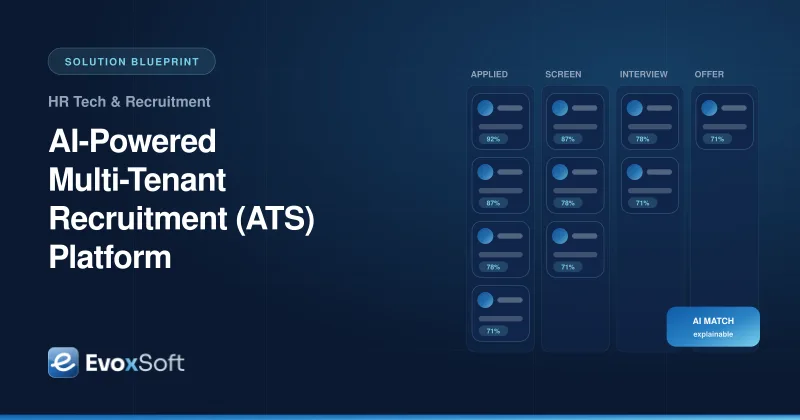
Applications from careers sites and job boards are parsed, enriched and matched per tenant. The AI ranks and explains, and recruiters decide. Every search and match is restricted to the tenant's own candidates.
The situation
Recruitment platforms serve two demanding audiences at once. Employers and staffing agencies want speed: fewer hours spent reading resumes, fewer back-and-forth emails to schedule interviews, and a clear view of where every candidate stands. Candidates and regulators want fairness and privacy: to know how their data is used, to have it deleted when they ask, and to be sure no algorithm is quietly rejecting them. A modern ATS has to deliver both, for many tenants, on one platform.
Our approach
1. Build tenant isolation into every layer
Every candidate, job and application belongs to exactly one tenant. PostgreSQL row-level security enforces this on every query, and the search index is partitioned per tenant so a keyword or semantic search can never surface another company’s candidates. Staffing agencies that serve several clients get a hierarchy of sub-tenants with explicit sharing rules instead of ad hoc exceptions.
2. Give each tenant its own hiring process
Tenants configure their own careers site (branding, custom domain, job listings and application forms), hiring stages, scorecard templates, approval steps for offers, and email templates. The careers sites are server-rendered with structured JobPosting data so listings can appear in Google’s job search. Interview scheduling syncs with Google and Microsoft calendars and lets candidates pick from real availability.
3. Use AI to assist recruiters, not replace them
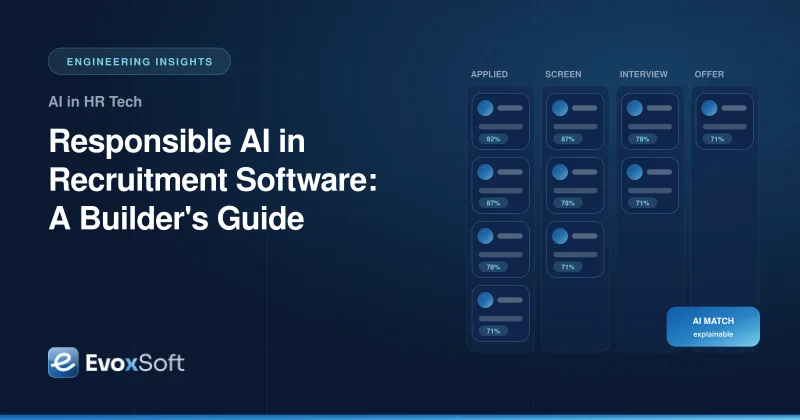
AI does the tedious work. It parses resumes into structured profiles, suggests skills and titles, drafts job descriptions and candidate emails for a recruiter to edit, and ranks applicants against the job’s stated requirements. Every match score comes with its evidence: the skills and experience that matched and the requirements that were missing. That way recruiters can see why, and candidates can get a meaningful explanation. The system never rejects anyone automatically. Moving a candidate forward or rejecting them is always a human action, and it is recorded.
4. Design for fairness and regulation
Hiring is one of the most regulated uses of AI. New York City’s Local Law 144 requires bias audits for automated employment decision tools, and the EU AI Act classifies recruitment AI as high-risk. We design the platform so our clients can meet these obligations:
Matching models exclude protected attributes and common proxies such as names, photos, ages and addresses.
An optional blind-review mode masks identifying details in early stages.
Stage-by-stage outcomes are logged so adverse-impact reports can be produced per job and per tenant.
AI features can be disabled per tenant or per region.
5. Automate privacy obligations
Consent is captured at application time with the tenant’s own privacy notice. Retention rules run as scheduled jobs that anonymize or delete candidate data when its retention period ends. Data-subject requests (export or delete) are handled through an admin workflow with an audit trail instead of manual database work.
How we deliver it
We start with the core ATS (jobs, careers site, pipelines, resume parsing) for a pilot tenant, then add scheduling, AI matching and analytics. AI matching first runs in shadow mode: recruiters see the scores beside their own decisions so we can measure agreement and check for adverse impact before it is shown by default. The recruiter workspace is responsive, and hiring managers can review candidates and submit scorecards from their phones; see our web and mobile app development service. The platform runs on AWS with infrastructure as code and per-environment isolation; see our cloud services.
Is this relevant to you?
If you are building an ATS or recruiting product, or adding AI to one and need it to hold up to customer security reviews and hiring regulations, this blueprint is a practical starting point. Explore our custom software development service or talk to us about your platform.
Building something similar?
We'll walk through your requirements and share how we'd approach architecture, timeline and team for your project.
We use essential technologies to run this site. With your OK, we also use cookieless analytics and Google Maps, which may set cookies. No ads, and we never sell your data. Cookie Policy
Privacy preferences
Choose which optional technologies we may use. Strictly necessary ones are always on because the site can’t work securely without them. Details are in our Cookie Policy.
Your browser sends a Global Privacy Control signal, so optional technologies are off by default.
Strictly necessary
Security and spam protection (Cloudflare, Google reCAPTCHA), form delivery, and remembering these choices.
Always on
Cloudflare Web Analytics counts page views without cookies or cross-site tracking.
Shows our office on Google Maps. Google may set cookies and receive your IP address.