A fintech engineering team ships several services a week, but releases depend on manual steps, a few people with production access and screenshots gathered for auditors. This blueprint shows how we build a delivery platform where every change is tested, scanned, approved and traceable from commit to production.
Deployments rely on runbooks and manual kubectl commands, so releases are slow and hard to repeat.
Auditors ask who changed what in production, and the answer takes days of digging through chat and tickets.
Vulnerable dependencies and misconfigured containers are found late, sometimes after release.
Environments drift apart because infrastructure was created by hand in the cloud console.
What the Solution Delivers
Every production change traceable to a reviewed pull request and pipeline run
Releases rolled out gradually and rolled back automatically on failing metrics
Security scans and policy checks that block unsafe changes before deployment
Environments rebuilt from code, with drift detected and reported
Architecture
GitOps delivery platform architecture
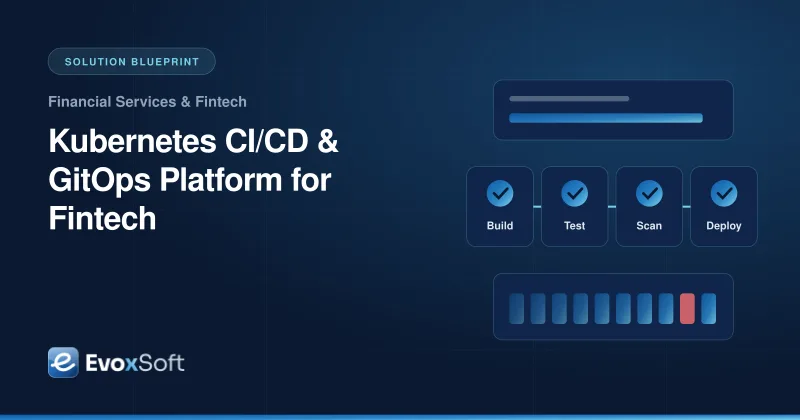
Developers merge to Git, CI builds, tests and scans an image, and the new version is committed to a config repository. Argo CD syncs the cluster to that repository, and Argo Rollouts shifts traffic gradually while Prometheus metrics decide whether to continue.
The situation
Fintech teams move quickly, but they also answer to auditors, banking partners and security reviewers. In many teams the delivery process grows informally: a CI job builds the code, a senior engineer runs the deployment, and evidence for compliance reviews is collected by hand at the end of each quarter. It works until the team doubles in size, a release goes wrong at night, or a partner asks for proof of change management that nobody can produce quickly.
Teams in this situation need a delivery platform where the safe path is also the fastest path, and where audit evidence is a by-product of normal work.
Our approach
1. Assess the current delivery path
We spend the first two to three weeks mapping how code reaches production today: repositories, branching, build tools, secrets, who has access to what, and which controls your compliance framework expects. If you are preparing for SOC 2 or PCI DSS, we map each change-management and access control to a concrete platform feature, so the design answers the auditor’s questions directly.
2. Define all infrastructure as code
We move clusters, networks, databases and IAM into Terraform modules stored in Git, with plans reviewed in pull requests and applied only by the pipeline. Nobody needs console write access for routine work. Scheduled drift checks compare live resources with the code and report differences.
3. Build pipelines with security built in
Each service gets a standard GitHub Actions pipeline: unit and integration tests, static analysis, dependency and container scanning with Trivy, a software bill of materials and image signing. Findings above an agreed severity fail the build. Secrets come from HashiCorp Vault at runtime instead of pipeline variables.
4. Deploy through GitOps
The pipeline never talks to the cluster directly. It commits the new image version to an environment configuration repository, and Argo CD syncs the cluster to match. Promotion from staging to production is a reviewed pull request, which gives you a four-eyes approval and a permanent, timestamped record of every change. OPA Gatekeeper policies reject workloads that run as root, lack resource limits or pull unsigned images.
5. Release gradually and watch the numbers
Argo Rollouts sends a small share of traffic to each new version, then increases it in steps. At each step, Prometheus queries check error rates and latency against the stable version. If a check fails, the rollout reverts on its own and alerts the team. OpenTelemetry traces and Grafana dashboards make it clear which version handled which request.
How we deliver it
We build the platform alongside one or two pilot services, then publish reusable pipeline templates and Helm charts so other teams can adopt it without starting from scratch. Runbooks, on-call dashboards and an evidence guide for auditors are part of the handover, and your engineers run the final migrations with our support.
We also agree on a small set of delivery metrics at the start, such as deployment frequency, lead time for changes, change failure rate and time to restore service. They are reported from pipeline and incident data automatically, so the team can see whether the platform is making releases safer and faster, and adjust the rollout plan if it is not. Access to production is reviewed as part of the handover, with break-glass accounts logged and time-limited. Learn more about our DevOps consulting and cloud services.
Is this relevant to you?
If releases depend on a few people, audit preparation takes weeks, or security findings arrive after deployment, this platform design is a good fit. It works for teams already on Kubernetes and for teams planning to move there. Contact us to review your current delivery path.
Building something similar?
We'll walk through your requirements and share how we'd approach architecture, timeline and team for your project.
We use essential technologies to run this site. With your OK, we also use cookieless analytics and Google Maps, which may set cookies. No ads, and we never sell your data. Cookie Policy
Privacy preferences
Choose which optional technologies we may use. Strictly necessary ones are always on because the site can’t work securely without them. Details are in our Cookie Policy.
Your browser sends a Global Privacy Control signal, so optional technologies are off by default.
Strictly necessary
Security and spam protection (Cloudflare, Google reCAPTCHA), form delivery, and remembering these choices.
Always on
Cloudflare Web Analytics counts page views without cookies or cross-site tracking.
Shows our office on Google Maps. Google may set cookies and receive your IP address.